BUYER GUIDE
Why PCB Recycling Matters for Southeast Asian E-Waste Recyclers
Printed circuit boards are the most value-dense component in discarded electronics. A single tonne of waste boards can contain more copper than many mined ores, along with trace amounts of gold, silver, and palladium. For e-waste recyclers in Vietnam, Indonesia, Thailand, Malaysia, and the Philippines, recovering these metals is not just an environmental obligation—it is a revenue opportunity. But doing it profitably requires the right equipment and a clear understanding of the process.
This guide explains how a circuit board recycling machine line works, what output fractions are worth recovering, and how to select equipment that fits your operation. It is written for buyers who need practical answers, not marketing fluff.
- A complete PCB recycling line uses shredding, granulating, and separation to concentrate metals from non-metallic fractions.
- Recovered copper, aluminum, and mixed metal concentrates are the main saleable outputs; non-metallic powder can be a secondary product or disposed of properly.
- When selecting equipment, evaluate feed material, throughput needs, separation efficiency, and after-sales support—not just the purchase price.
- For most small to mid-scale recyclers, an integrated line with air classification and magnetic separation offers the best balance of simplicity and recovery.
How a PCB Recycling Machine Line Works
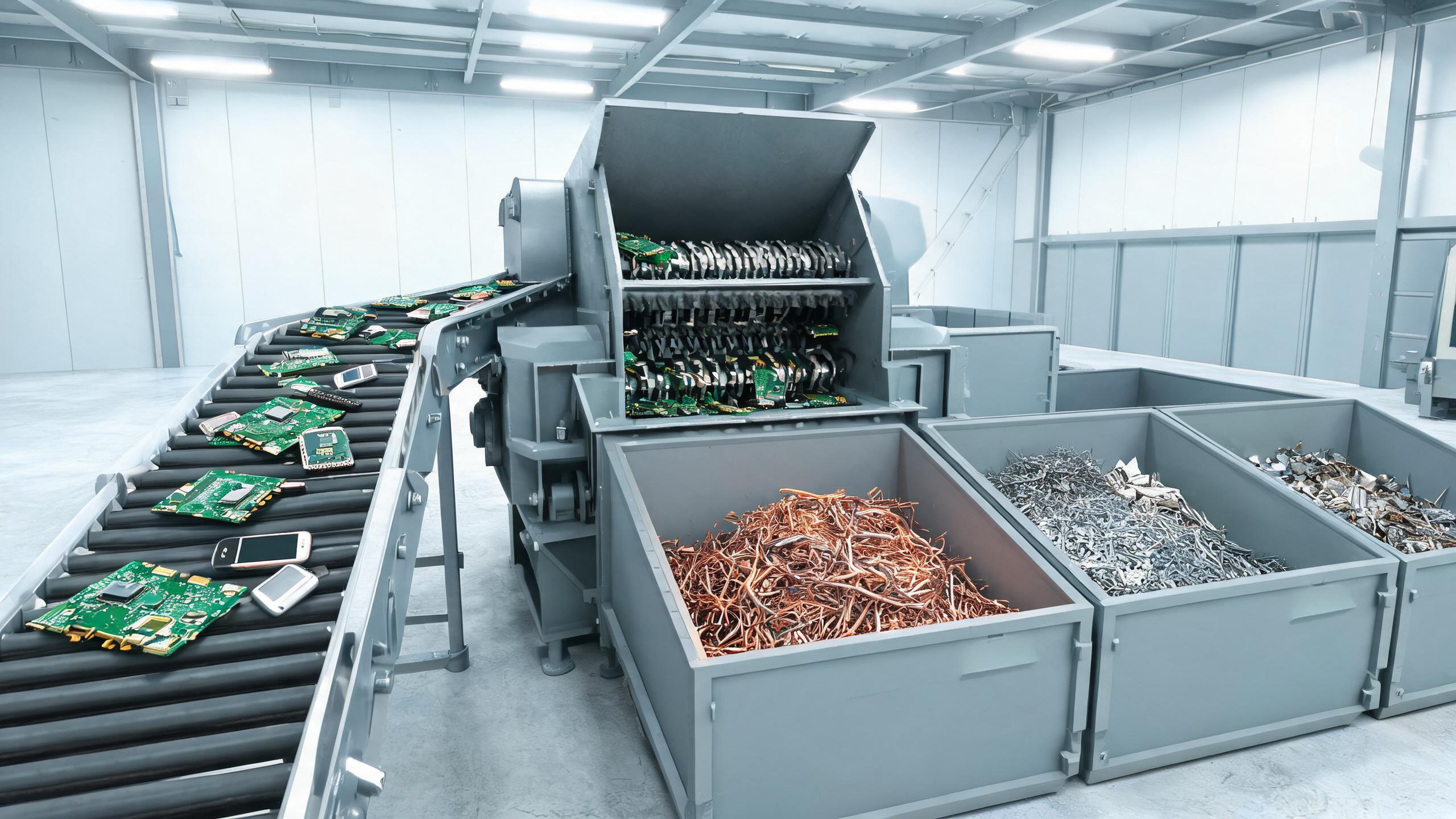
A typical circuit board recycling machine line follows three main stages: size reduction, granulation, and separation. Each stage prepares the material for the next, ultimately producing clean metal fractions and a non-metallic residue.
Stage 1: Shredding
Whole circuit boards are too large and rigid for direct processing. The first step is a twin-shaft shredder that breaks boards into coarse pieces. This stage reduces volume and exposes the internal layers, making subsequent granulation more effective. Shredding also helps separate components from the board substrate, though further processing is needed to liberate the metals.
Stage 2: Granulating
The shredded material moves to a granulator, which further reduces particle size to a few millimeters. At this size, the bond between copper foil, solder, and the fiberglass-epoxy substrate is broken. Granulation is critical because efficient separation depends on the metal particles being fully liberated from the non-metallic matrix. If the material is not granulated finely enough, metal recovery drops and the purity of output fractions suffers.
Stage 3: Separation
After granulation, the mixture of metal and non-metal particles is separated using a combination of technologies:
- Magnetic separation removes ferrous metals (iron and steel) from the stream.
- Eddy current separation repels non-ferrous metals like copper and aluminum, separating them from plastics and fiberglass.
- Air classification uses airflow to separate lighter non-metallic particles from heavier metal particles based on density and size.
These methods work together to produce distinct output fractions: a ferrous metal fraction, a non-ferrous metal concentrate (mainly copper), and a non-metallic powder. The non-metallic powder, often called resin powder, can be further processed or used as filler in construction materials, though its market value is lower.
For a complete solution, the TG-EWasteLine 150 E-Waste Metal Recovery Line integrates all these stages into a single system. It includes a twin-shaft shredder, granulator, magnetic separator, eddy current separator, and air classification, allowing you to process discarded electronics—after battery removal—into concentrated metal-bearing fractions ready for downstream refining or sale.
What Output Fractions Are Worth Recovering
Understanding the value of each output fraction helps you decide which materials to prioritize and how to price your services. The table below summarizes the main fractions and their typical uses.
| Output Fraction | Composition | Market Value | Typical Buyer |
|---|---|---|---|
| Copper concentrate | High copper content, small amounts of other non-ferrous metals | High—copper prices drive the economics | Smelters, metal traders, refiners |
| Ferrous metal fraction | Iron and steel from frames, connectors, and components | Moderate—sold as scrap steel | Steel mills, scrap yards |
| Aluminum concentrate | Aluminum from heatsinks, casings, and some components | Moderate—aluminum prices are lower than copper | Aluminum recyclers |
| Non-metallic powder | Fiberglass and epoxy resin | Low—may require disposal or upcycling | Construction material producers, waste-to-energy plants |
Precious metals like gold and silver are present in trace amounts on board surfaces and in components. They are not recovered directly by mechanical separation; instead, they concentrate in the copper fraction and are recovered later during smelting or refining. Therefore, the value of your copper concentrate is enhanced by its precious metal content, making it more attractive to downstream refiners.
How to Select a Circuit Board Recycling Machine
Choosing the right equipment is a major investment. Here are the key factors to evaluate before making a decision.
Feed Material and Throughput
Define what you will process: whole boards, populated boards, or mixed e-waste. The composition and volume determine the required capacity. A line rated for a certain throughput in kilograms per hour must match your expected input. Over-sizing wastes capital; under-sizing creates bottlenecks.
Separation Efficiency
The goal is to maximize metal recovery while minimizing metal loss in the non-metallic fraction. Ask the supplier how their separation system achieves this. Look for a line that combines multiple separation technologies—such as magnetic, eddy current, and air classification—because no single method handles all materials effectively.
Build Quality and Safety
Processing electronics involves dust, noise, and potential fire hazards. Ensure the equipment is robust, with proper dust collection and safety features. CE marking indicates compliance with European safety standards, which is a good baseline for quality. Tiangong equipment is CE-marked, reflecting a commitment to safety and reliability.
After-Sales Support and Warranty
Machinery will need maintenance. Check the warranty period and the supplier's ability to provide spare parts and technical support. A 12-month warranty is standard in the industry; longer terms may indicate confidence. Also, consider the supplier's location and response time. Tiangong, founded in 2008, operates a 12,000 m² facility and offers lead times under 45 days for standard models, which can help you plan your installation.
Integration and Footprint
Some recyclers prefer separate units that can be expanded later; others want a fully integrated line that saves floor space and simplifies operation. Integrated lines like the TG-EWasteLine 150 are easier to manage and often have lower installation costs.
Comparison: Integrated Line vs. Separate Units
| Factor | Integrated Line | Separate Units |
|---|---|---|
| Floor space | Compact, designed for continuous flow | Requires more space for individual machines and conveyors |
| Installation | Simpler, factory-tested modules | More complex, requires on-site assembly and tuning |
| Operation | Single control system, fewer operators | Multiple controls, more supervision |
| Flexibility | Less flexible for changing feed types | Can be reconfigured for different materials |
| Cost | Often lower total investment | May be higher due to additional conveyors and controls |
For most small to mid-scale recyclers in Southeast Asia, an integrated line is the practical choice. It reduces complexity and gets you operational faster.
Case Example: Cable and Wire Recycling
While this guide focuses on circuit boards, many recyclers also process cables and wires, which contain valuable copper or aluminum conductors. The TG-CableLine 100 Cable and Wire Recycling Line is designed specifically for this task. It uses a twin-shaft shredder, granulator, air separation, and vibration table to separate the metal conductor from the plastic insulation. If you handle both boards and cables, you may need two dedicated lines, as the processing requirements differ.
Common Mistakes to Avoid
- Buying without testing your material: Always run a sample through the equipment before purchase. A reputable supplier will offer this service.
- Ignoring dust control: PCB recycling generates fine dust that can be hazardous. Ensure the line has adequate dust collection to protect workers and comply with local regulations.
- Underestimating maintenance: Blades and screens wear out. Factor in the cost and availability of spare parts.
- Assuming all boards are the same: Different board types (e.g., single-layer, multi-layer, with or without components) have different metal contents and require different processing parameters.
Frequently Asked Questions
Do I need a special license to operate a PCB recycling machine?
Regulations vary by country. In Vietnam, Indonesia, Thailand, Malaysia, and the Philippines, e-waste processing is increasingly regulated. Check with your local environmental agency for permits and compliance requirements.
Can I recover gold and silver with this type of machine?
Mechanical separation concentrates metals but does not extract pure gold or silver. These precious metals are recovered during downstream smelting or chemical refining. The value is in the enriched copper concentrate.
What is the typical payback period?
Payback depends on your input volume, metal prices, and operational costs, so it varies widely between operations. Request a detailed calculation from the supplier based on your specific situation.
How do I ensure the machine meets safety standards?
Look for CE marking, which indicates compliance with European safety directives. Also, check for local certifications and ask for documentation.
Next Steps: Get a Tailored Recommendation
Selecting a circuit board recycling machine is not a one-size-fits-all decision. Your feed material, scale, and local market for output fractions all influence the right choice. Tiangong, with over 15 years of experience (since 2008) and a 12,000 m² facility, can help you evaluate your needs. Our standard models ship in under 45 days, and we offer a 12-month warranty on all equipment.
Contact us today to discuss your processing requirements and request a sample test. Our team will work with you to design a solution that maximizes your metal recovery and profitability.
"The right machine is not the one with the lowest price, but the one that recovers the most value from your specific waste stream."
For more information, explore our TG-EWasteLine 150 and TG-CableLine 100, or reach out to our sales team for a personalized consultation.