Recyclers in Vietnam, Indonesia, Thailand, Malaysia, and the Philippines are increasingly handling WEEE (waste electrical and electronic equipment) from local collection schemes and imported e-scrap. The challenge is not just volume—it is separating usable metal fractions from plastics, boards, and cables while meeting import and export compliance requirements. This article explains the equipment stages a WEEE processing line needs, and the compliance points that affect line design and operation.
Why Line Configuration Matters
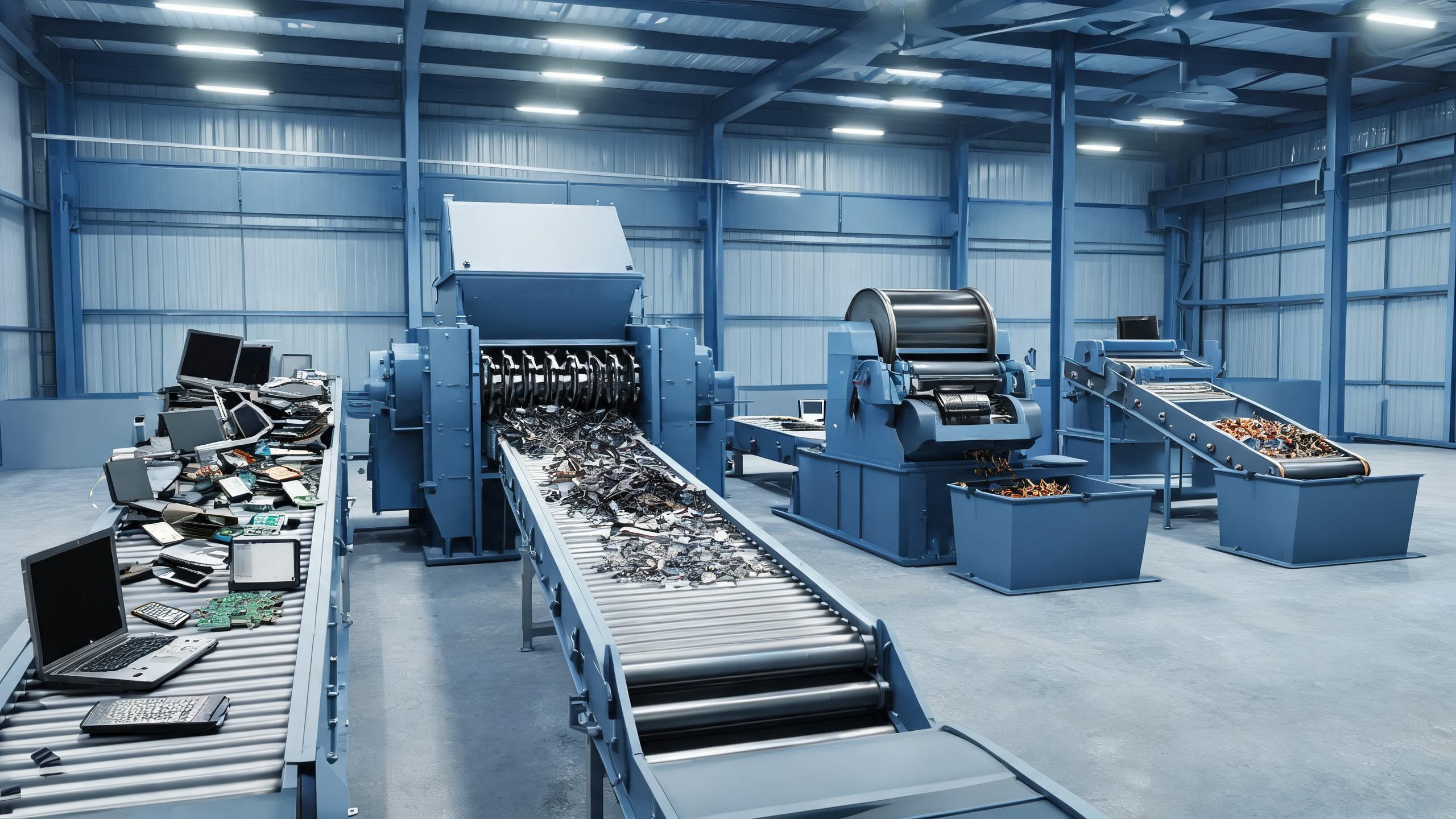
A WEEE shredding line is not a single machine. It is a sequence of size-reduction and separation steps that turn mixed electronics into marketable fractions: ferrous metal, non-ferrous metal (aluminium, copper), and concentrated metal-bearing residue. The configuration determines recovery rate, purity, and operating cost. For Southeast Asian recyclers, the right configuration also affects whether you can meet the quality specifications of local smelters and international buyers.
Typical throughput for such lines ranges from 2 to 30 t/h depending on material. Smaller operations start with a single shredder and add separation stages as volume grows. Larger operations invest in an integrated line that combines all stages from the start.
Core Equipment Stages
Every WEEE line follows the same logic: reduce size to liberate materials, then separate by physical properties. The standard stages are:
- Primary shredding – reduces whole appliances or bulk e-scrap to a coarse fraction.
- Granulation – further reduces the material to liberate metals from plastics.
- Magnetic separation – removes ferrous metals (steel, iron).
- Eddy current separation – extracts non-ferrous metals (aluminium, copper).
- Air classification – separates light fractions (plastic, dust) from heavier metal concentrates.
An integrated line, such as the TG-EWasteLine 150 E-Waste Metal Recovery Line, combines these stages in a single system. It includes a twin-shaft shredder, granulator, magnetic separator, eddy current separator, and air classification, recovering ferrous, non-ferrous, and concentrated metal fractions from electronics after battery removal. This type of line is designed to be installed as a complete unit, reducing integration risk.
Primary Shredding
The first stage uses a twin-shaft shredder to tear apart casings, circuit boards, and cables. The rotor knife profile and screen mesh opening determine the output particle size, which affects downstream separation efficiency. For example, the TG-2200 Twin-Shaft Metal Shredder is a primary unit that can be matched to a line based on feed size and throughput. Tiangong, a manufacturer founded in 2008, configures rotor knife profiles, screen mesh openings, and hopper dimensions to suit the material specification.
Granulation
After primary shredding, a granulator further reduces particles to a uniform size. This step is critical for liberating copper wires from plastic insulation and separating aluminium from plastic housings. The finer the granulation, the better the subsequent separation, but also the higher the energy consumption. The right balance depends on the target purity and the value of the recovered metals.
Magnetic Separation
Ferrous metals are removed using overhead or drum magnets. This stage is simple but essential—steel from appliance casings and motors is a high-volume, lower-value fraction that must be separated before further processing. The magnet position and belt speed affect recovery rate.
Eddy Current Separation
Eddy current separators use a rotating magnetic field to repel non-ferrous metals. This stage recovers aluminium, copper, and other non-ferrous metals from the non-magnetic stream. The efficiency depends on particle size and shape; well-granulated material yields better separation.
Air Classification
The final stage uses airflow to separate light materials (plastics, foam, dust) from heavier metal concentrates. This produces a cleaner metal fraction that commands a higher price. The air classification also helps remove dust, which improves working conditions and reduces fire risk.
Compliance and Feed Preparation
Compliance is not an afterthought—it affects line design and operation from day one. For Southeast Asian recyclers, the key compliance points are:
- Battery removal – Lithium-ion batteries in e-waste are a fire hazard during shredding. They must be removed before the material enters the line. This is a manual step, often done at a pre-sorting station. The line design must include a clear feed preparation area where batteries, capacitors, and other hazardous components are removed.
- Feed preparation – Large appliances may need to be pre-cut to fit the shredder feed opening. This can be done with a shear or manually. The line configuration should account for the feed size and the need for pre-processing.
- Export/import regulations – Many Southeast Asian countries regulate the import of e-waste under the Basel Convention. Exporters must ensure that the material is classified correctly and that the processing line meets the requirements of the destination country. This may affect the choice of equipment, particularly for lines that handle imported e-scrap.
- Environmental permits – Shredding and separation can generate dust and noise. Local permits may require dust collection systems or noise reduction measures. Air classification helps reduce dust, but additional filtration may be needed.
Key takeaway: Battery removal is non-negotiable. It is a manual step that must be integrated into the line design, not an afterthought. A line that does not plan for battery removal is a fire risk.
Choosing a Supplier
When evaluating suppliers for a WEEE shredding line, consider the following checklist:
| Checklist Item | Why It Matters |
|---|---|
| Manufacturing experience | Proven track record reduces risk of design flaws. |
| Facility size and capacity | Indicates ability to handle large orders and custom work. |
| Lead time | Affects project planning; standard models should have predictable delivery. |
| CE marking | Required for export to many markets; indicates compliance with EU safety standards. |
| UL-compliant panels | Important for electrical safety in North American and some Asian markets. |
| Warranty and spare parts | Reduces downtime and maintenance costs. |
| Installation and training | Ensures the line is set up correctly and operators are trained. |
For example, Tiangong, a manufacturer founded in 2008, operates a 12,000 m² facility and offers lead times under 45 days for standard models. Equipment is CE-marked, and UL-compliant panels are available on request. They provide a 12-month warranty with spare-parts kits, and installation supervision and operator training. Their engineering team configures rotor knife profiles, screen mesh openings, and hopper dimensions to match the material specification. This level of customization is important because e-waste composition varies by region and season.
When comparing suppliers, ask for the following:
- Reference installations in Southeast Asia (if available).
- Detailed line diagrams with material flow and recovery rates.
- Specifics on how the line handles battery removal and feed preparation.
- Compliance documentation (CE, UL, etc.) for the specific model.
- Spare parts availability and service response times.
FAQ
What is the difference between a WEEE line and a cable recycling line?
A WEEE line processes mixed electronic waste, including boards, housings, and cables. A cable recycling line is specialized for cables and wires, focusing on separating copper and aluminium from plastic insulation. For example, the TG-CableLine 100 Cable and Wire Recycling Line is designed specifically for that purpose. If you handle a mix of e-waste and cables, you may need both types of equipment.
Do I need to remove batteries before shredding?
Yes. Lithium-ion batteries can catch fire during shredding. They must be removed manually before the material enters the line. This is a critical safety step that should be included in your feed preparation process.
What throughput should I choose?
Throughput depends on your input volume and the composition of your e-waste. Typical lines range from 2 to 30 t/h. Start with a realistic estimate of your daily intake, then select a line that can handle peak volumes with some margin.
How do I ensure the recovered metals meet buyer specifications?
The purity of recovered metals depends on the completeness of the separation stages. A well-configured line with granulation, magnetic separation, eddy current, and air classification will produce higher purity fractions. You should also test your output regularly and adjust settings as needed.
What compliance documents should I request from a supplier?
Ask for CE certificates for the equipment, and if you plan to sell into North America, UL-compliant panels. Also request documentation on the line's safety features, such as emergency stops and dust collection.
Planning a WEEE line for your market? Contact us to discuss your material composition and throughput requirements. Our engineering team can configure a line to match your feed and compliance needs.